
Feature Stories
August 18, 2026 | Volume 10, Number 8
Collaboration Key to Tri-Valley’s Accomplishments
By Deborah Branscum, Hacienda Pulse Staff Writer
Collaboration is the foundation of civic achievement. The founding of the United States, for example, grew out of resistance to the Stamp Act. As historian Heather Cox Richardson notes, opposition was led by a group of “dock hands, sailors, and workers,” who called themselves the Sons of Liberty. “John Adams’s cousin Samuel Adams, who was deeply involved with the Sons of Liberty, recognized that building a coalition in defense of liberty within the British system required conversation and cooperation.”
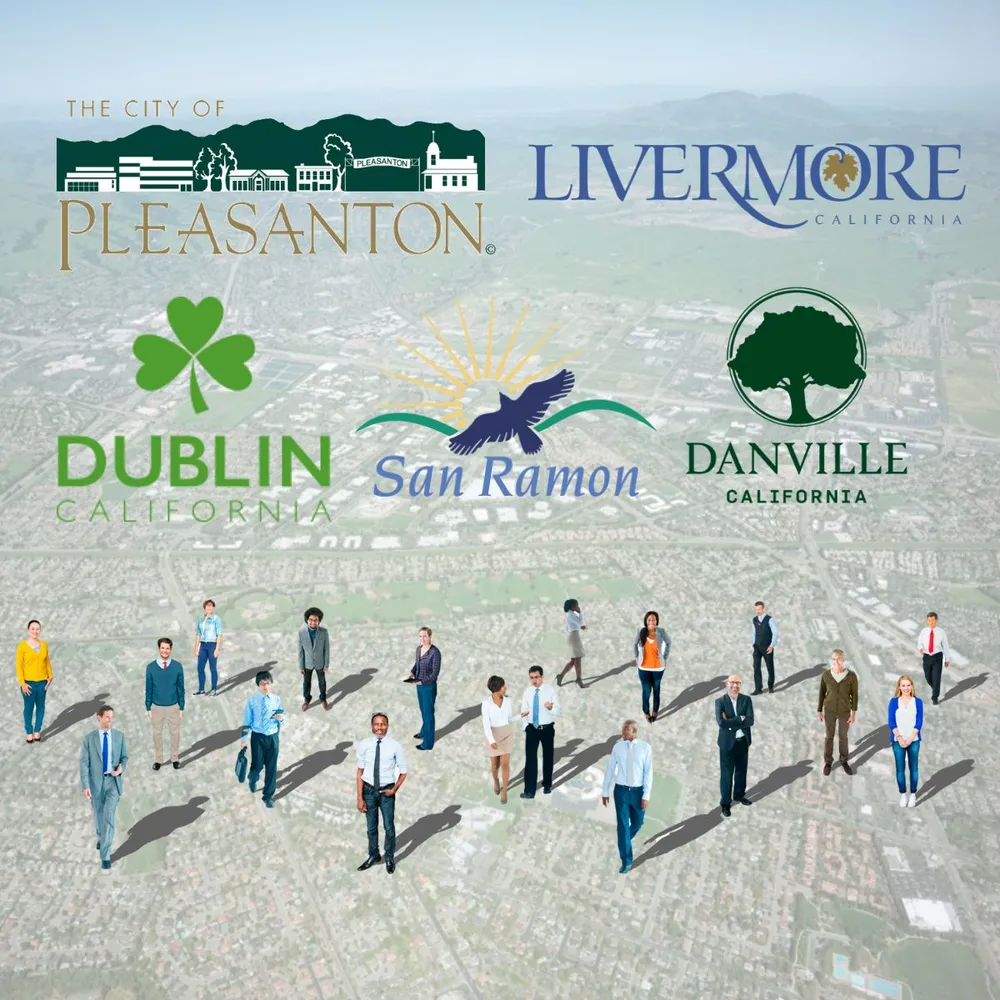
The history of the U.S. is a rich tapestry thick with shining examples of the power of cooperation, from the creation of the U.S. constitution to the architectural innovation of the Golden Gate Bridge. The success of the Tri-Valley is also a story of collaboration. In ways both large and small, the region’s city and county public officials, agency staff members, nonprofit organizations, and business groups work together to strengthen the economy, improve infrastructure, and expand human services.
Collaboration Flourishes Here
Business leaders, nonprofit executives, and officials from Tri-Valley cities agree: Collaboration is a hallmark of the region, and has been for some time. Leaders and officials say several factors help cooperation thrive in the Tri-Valley. One reason is that individuals in the private, nonprofit, and public sectors all understand the value of working together as a region. Another is the strong network of cross-region and cross-sector relationships that have grown and expanded over the years.
To Stephen Baiter, Executive Director of the East Bay Economic Development Alliance, working together at the regional level simply makes sense. “Leaders from business, government, and nonprofit organizations can often partner most effectively when tackling problems at the local and regional level, where greater numbers of people have shared experiences with using local resources, services, and systems. These shared experiences–such as how people find and utilize things such as childcare, education, and transportation–brings together different groups in a way that positions them to develop solutions around mitigating challenges with access, funding, or other issues.”
Collaboration is “the defining characteristic of how this region operates, and it's unusual enough that people who move here from other metro areas often remark on it,” says Katie Marcel, CEO of Innovation Tri-Valley Leadership Group (ITV). “ITV's own Leadership Group includes elected officials and economic development professionals from every Tri-Valley city and county, sitting at the same table as business leaders, the national labs, and education partners. That's not symbolic, it's how decisions actually get made here. Most regions treat economic development as a zero-sum competition between neighboring cities for the same employer or the same tax base. The Tri-Valley doesn't operate that way, and hasn't for a long time.”
According to Kathy Young, President/CEO of the Tri-Valley Nonprofit Alliance (TVNPA), “Collaboration is one of the Tri-Valley’s greatest strengths, particularly within the nonprofit community. Organizations recognize that no single nonprofit, business, city, or agency can address our region’s challenges alone. They regularly share resources, make referrals, coordinate services, and create partnerships that allow each organization to contribute what it does best.”
“In my experience, the Tri-Valley's reputation for cooperation is well deserved,” says Yolanda Fintschenko, Ph.D., Executive Director of i-GATE Innovation Hub and Daybreak Labs. “One of the clearest examples is i-GATE Innovation Hub itself. For more than 15 years, the Cities of Livermore, Pleasanton, and Dublin, the Town of Danville, the Alameda County Board of Supervisors, Lawrence Livermore National Laboratory, and Sandia National Laboratories have supported a shared vision for innovation and economic development. Rather than creating separate startup initiatives, these organizations funded a common platform designed to support entrepreneurs, researchers, students, investors, and employers across the region. I think this works because innovation ecosystems do not stop at city boundaries. Founders, talent, investors, and employers move throughout the region, and most startups are deciding between the Tri-Valley and other innovation hubs, not between neighboring cities. Many local leaders recognize that success in one community benefits the region as a whole.”
Ken Minn, Zone 7 Water Resources Manager, echoes that sentiment. “We need to work together to ensure water supply reliability and fulfill our mission, so collaboration is essential. We recently completed a 30-year renewal of our water supply contracts with our retail water agencies, and that agreement was the result of a collaborative effort among the agencies. Water conservation is another example of how we work together to achieve common goals for the region. That spirit of collaboration extends beyond water agencies. Elected officials, business organizations, and community partners throughout the Tri-Valley share that commitment. Over time, strong relationships have developed at the staff, executive, and board levels, and people know who to call and how to work together. Those relationships make it easier to collaborate, solve problems, and move important regional initiatives forward.”
As the Economic Development Manager in the Community and Economic Development Department of the City of Pleasanton, Abraham Salinas has witnessed regional collaboration in action. “In my experience, there is a strong culture of regional cooperation. Local governments, business organizations, educational institutions, nonprofits, and major employers regularly share information, coordinate initiatives, and advocate for common priorities. That does not mean competition is absent. However, that competition generally occurs within a broader understanding that the Tri-Valley functions as an interconnected regional economy. A business located in Livermore, Dublin, San Ramon, or Danville may employ Pleasanton residents, purchase services from Pleasanton companies, or strengthen an industry cluster that benefits the entire region. The same is true when a company invests in Pleasanton. Regional economic growth expands employment opportunities, supports local suppliers, and strengthens the Tri-Valley’s overall reputation as a location for innovation and business investment.”
Examples Abound
Salinas notes that the Tri-Valley’s communities have “distinct but complementary economic strengths. Pleasanton is a major corporate and innovation center, with a strong concentration of technology, life-science, and healthcare employers supported by high-quality office and research-and-development space. Dublin deserves particular recognition for its emerging artificial-intelligence cluster, which includes firms developing generative and agentic AI solutions. The city also hosts the annual Tri-Valley AI Summit, connecting AI companies, researchers, investors, and business leaders. Livermore similarly stands out as an advanced-manufacturing center, supported by its national laboratories, specialized research facilities, and companies producing clean-transit, agricultural, and other advanced technologies. San Ramon contributes a strong corporate and professional-services presence, while Danville offers an active small-business community and quality-of-life amenities that help attract and retain talent. Together, these strengths create a more complete and resilient regional economy than any one community could offer independently.”
Workforce development is one area rich in cooperative efforts, according to Melinda M. Denis, Deputy Director of Community and Economic Development for the City of Pleasanton. “Employers draw talent from across city and county lines, and workers often live, commute, and work in different parts of the Tri-Valley. Collaboration among cities, employers, educational institutions, workforce boards, Chambers of Commerce, and nonprofit organizations is important to helping businesses find talent and helping residents access career pathways. This is especially relevant in sectors such as advanced manufacturing, life sciences, professional services, technology, healthcare, hospitality, and the skilled trades. No single city can solve workforce needs alone, so regional coordination is essential.”
One notable workforce initiative, called Healthforce Partners, was launched when ITV convened Sutter Health, Stanford Health Care Tri-Valley, Kaiser Permanente, John Muir Health, Las Positas College, and both Alameda and Contra Costa counties, bringing key regional partners together under ITV's oversight for the greater good. “It stitched together hospital systems, healthcare institutions, higher ed, K to12 pipelines, workforce training programs, and county workforce development services into a single coordinated effort to build the healthcare talent pipeline this region is going to need,” according to Marcel. “That's a lot of institutions that don't normally share a table–competing hospital systems, multiple school districts, county agencies–aligned around the recognition that no single one of them can solve the healthcare workforce shortage alone.”
Brandon Cardwell, Director of Innovation and Economic Development for the City of Livermore, believes the strong culture of collaboration within the Tri-Valley is partly the result of “a recognition that many of the challenges and opportunities facing our communities do not stop at jurisdictional boundaries. Issues such as homelessness, housing, transportation, economic development, and infrastructure are inherently regional. I have found that there is a genuine willingness among Tri-Valley partners to come together, share information and resources, and look for solutions that benefit the broader region.”
Cardwell cites regional transportation, homelessness and human services, and economic development as important areas where collaboration makes a difference. According to Salinas, transportation cooperation in the Tri-Valley dates back more than three decades. In 1991, Alameda County, Contra Costa County, Dublin, Livermore, Pleasanton, San Ramon, and Danville established the Tri-Valley Transportation Council.
Salinas notes that the seven jurisdictions jointly prepare regional transportation plans, establish priorities, and share responsibility for improvements affecting routes of regional significance. They also administer the Tri-Valley Transportation Development Fee, which allocates a portion of the infrastructure costs associated with new development to regionally significant transportation projects.
Christy Wegener works to improve regional transportation as the Executive Director of the Livermore Amador Valley Transit Authority, also known as LAVTA. “One area that I would highlight would be implementing transit signal priority (TSP) throughout the Tri-Valley, which is one of LAVTA’s top priorities," she says. “TSP allows for a few-second extension of a green light when a bus is approaching and over the course of the day, can result in real running time savings and improve bus service reliability. Traffic engineers don’t always want to grant TSP as they worry about the impact on signal timing and the general flow of traffic. But if we can get TSP right and really begin to move buses faster on our arterial roadways, we will build ridership and overall traffic will be positively impacted.” LAVTA is upgrading its TSP system currently; Pleasanton, Livermore, and Dublin officials support the project and have participated in the design of the new system, which will be expanded to other Tri-Valley cities over time.
The Tri-Valley Mayors Summit that took place last month is one example of business interests collaborating, according to Yianna Theodorou, President and CEO of the Pleasanton Chamber of Commerce. “The Tri-Valley Chambers take turns hosting the summit each year, bringing together the mayors from Pleasanton, Livermore, Dublin, San Ramon, and Danville to talk about issues and opportunities that affect not only their cities but the region as a whole. It’s a great example of the cities and business communities coming together to share ideas and work toward common goals. It’s also nice to see the camaraderie and support that the mayors express to one another. That so many of the people involved also have personal and professional connections across the Tri-Valley makes that cooperation feel very natural. I’ve seen that same spirit of collaboration in the relationships between our local Chambers, our cities, Visit Tri-Valley, the school districts, and other local organizations. There’s a lot of communication and cooperation happening behind the scenes.”
“Cooperation gives the Tri-Valley greater scale and influence,” according to Salinas. “Individually, each jurisdiction represents a relatively small portion of the Bay Area. Collectively, the Tri-Valley can present itself as a major employment center and innovation economy spanning five communities, two counties, two national laboratories, and a significant network of employers and educational institutions. A unified regional voice is particularly important when competing for state and federal funding, advocating for transportation investments, or marketing the area to employers and investors.”
Moreover, there is “a willingness among regional partners to promote resources and opportunities regardless of where they are physically located,” Salinas adds. “A startup may use laboratory space in Livermore, receive technical assistance from a regional program, attend an event in Dublin, and ultimately lease space in Pleasanton. The emphasis is often on retaining that company and its jobs within the Tri-Valley rather than treating every opportunity as a winner-take-all competition among jurisdictions.”
Las Positas College’s recent Run for Education “illustrates how nonprofits, businesses, and an educational institution can work together,” Young says. “Las Positas College provided the setting and managed the race, the Livermore Valley Chamber of Commerce helped engage local businesses, TVNPA selected and worked with the nonprofits, and the event raised funds benefiting 12 nonprofit organizations. There are many more examples, but all of them reflect the same principle: Collaboration allows us to stretch limited resources, reduce duplication, bring different sectors together, and provide more comprehensive support to the people who need it.”
As Salinas points out, the Tri-Valley has longstanding institutions that make collaboration routine and “repeatedly bring public, private, educational, and nonprofit leaders together. These sustained relationships help establish trust, institutional knowledge, and a shared understanding of the region’s priorities.” Ultimately, each regional collaboration is in service to improving the Tri-Valley as a whole. When such initiatives succeed, they also increase the quality of life for residents, employers, and the workforce.
"The Tri-Valley's greatest competitive advantage is not any single city, organization, or institution. It's the network connecting them,” Fintschenko says. “Cities, the county, national laboratories, educational institutions, nonprofits, investors, healthcare leaders, nonprofits, and businesses have spent years building relationships and trust. The companies and communities that benefit from those efforts are stronger because of it."
As Young notes, “Collaboration is not simply something Tri-Valley organizations discuss. It has become part of the way our community operates. When organizations trust one another, they are less concerned about who receives the credit and more focused on how they can combine their strengths to serve the community.”
For more information about the East Bay Economic Development Alliance, please visit www.eastbayeda.org.
For more information about the Innovation Tri-Valley Leadership Group, please visit www.innovationtrivalley.org.
For more information about the Tri-Valley Nonprofit Alliance, please visit www.tvnpa.org.
For more information about i-GATE Innovation Hub and Daybreak Labs, please visit www.igateihub.org.
For more information about the Zone 7 Water Agency, please visit www.zone7waterca.gov.
For more information about the City of Pleasanton, please visit www.cityofpleasantonca.gov.
For more information about the City of Livermore, please visit www.livermoreca.gov.
For more information about Livermore Amador Valley Transit Authority, please visit www.wheelsbus.com.
For more information about the Pleasanton Chamber of Commerce, please visit www.pleasanton.org.
Hacienda News and Information
Hacienda Online provides a great way to stay informed of all the latest at Hacienda


