
Feature Stories
September 15, 2026 | Volume 10, Number 9
Manufacturing Continues to Play a Key Role in Bay Area’s Economic Ecosystem
By Cierra Bailey, Hacienda Pulse Staff Writer
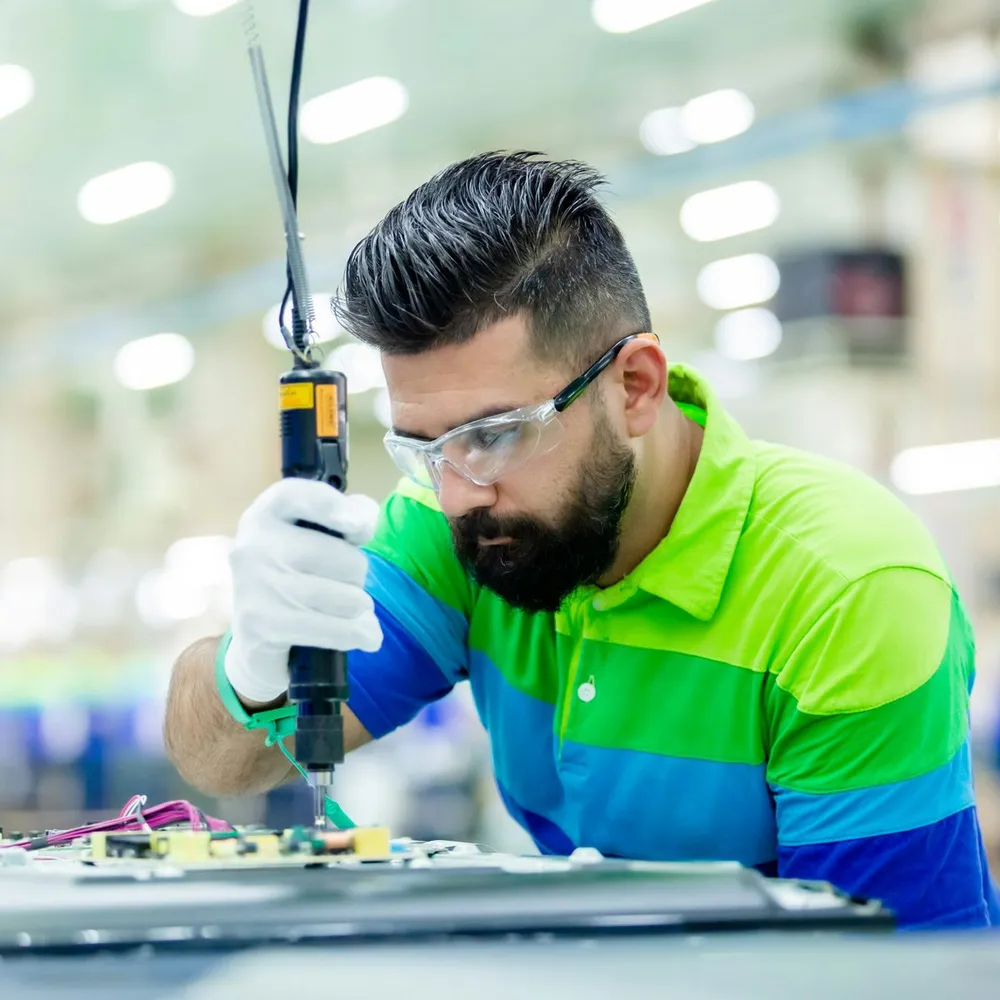
As Manufacturing Month approaches this October, industry leaders along with the International Trade Commission and the U.S. government will be joining forces to celebrate and amplify the importance of U.S. manufacturing innovation and ingenuity to everyday life.
Manufacturing is a longstanding and constantly evolving sector that contributes $2.9 trillion to the U.S. economy, employs nearly 12.9 million American workers, and accounts for 11% of the nation’s GDP, according to the International Trade Commission.
IndustrySelect – the manufacturers database built for sales, marketing, and go-to-market teams – ranks California as the nation’s largest manufacturing state with 21,290 manufacturers employing 1,296,379 manufacturing workers.
The East Bay – home to major companies such as Tesla, Clorox, Kaiser Permanente and Workday, among many others – remains at the cornerstone of advanced manufacturing.
East Bay Manufacturing Legacy
“The East Bay’s legacy of manufacturing and leadership in multiple technologies create synergy for cross-discipline innovation, with growing R&D investments in life sciences, clean energy, artificial intelligence, high performance computing, and software. The diversity of these economic activities keeps the region thriving and growing. The East Bay has attracted more venture capital than 40 states every year since 2000. In 2021, East Bay companies received over $10.4 billion in venture capital investment,” according to the East Bay Economic Development Alliance (East Bay EDA).
The East Bay region’s vibrant innovation ecosystem is fueled by a strong manufacturing legacy and leadership across diverse sectors and technologies, according to Resilient East Bay – an initiative that aims to strengthen connections and advance partnerships to ensure that the region’s manufacturing ecosystem receives ongoing investment and support.
Among industries including aerospace, biosciences to energy, food and advanced transportation, the area’s cross‑disciplinary innovation and manufacturing capabilities drive a dynamic and thriving region.
Industries with manufacturing are often interlinked within a regional economy through knowledge, capital, shared supply chains, and labor pools, forming industrial clusters that drive local economic growth. The East Bay is an industrial cluster made up of companies that manufacture electronics, drugs and medical devices, food and beverages, and climate and transportation technology products.
The current boom in AI and defense-related investment is helping to fuel a new wave of manufacturing innovations and technologies that are being funded and built by entrepreneurs and innovators in the Bay Area, according to East Bay EDA.
In addition to the East Bay’s collaborative environment and ability to attract a talented workforce, local jurisdictions also provide supportive policies, tax incentives and simplified regulations, which makes for a stable environment conducive to business development.
Resilient East Bay’s efforts seek to not only amplify the positive attributes of the region but to continue improving and strengthening them by connecting businesses with resources and information, while helping policymakers, support organizations and stakeholders gain deeper insight into the needs and opportunities for bolstering the East Bay’s manufacturing ecosystem.
“The East Bay Economic Development Alliance’s Resilient East Bay initiative was created to do exactly this: to showcase the region’s story and elevate its vibrant, interconnected innovation clusters. Also, by mapping the East Bay’s manufacturing companies and regional assets, the initiative works to reinforce the broader innovation ecosystem and networks,” said Carline Au, Head of Planning & Strategy with the East Bay EDA, in a statement back in February.
With the many emerging tech and science businesses planting roots in the Tri-Valley along with being home to the Lawrence Livermore National Laboratory and Sandia National Laboratory, the suburban Bay Area subregion has established itself over the years as an up-and-coming hub for innovation and helping drive the overall East Bay manufacturing ecosystem.
Beyond the East Bay region’s attraction to companies manufacturing goods, services and technologies, the greater Bay Area has the benefit of having the infrastructure to support exporting locally produced goods.
The East Bay has two international ports in Oakland and Richmond, which allow direct and efficient access to global supply chains and international markets, including direct links to Asia and the Middle East. The Port of Oakland is a premier global trade gateway for the U.S., handling 99% of all containerized goods moving through Northern California, according to East Bay EDA.
Additionally, San Francisco Bay Oakland International Airport (OAK) is the largest airport in the Bay Area for air cargo, serving as a regional hub for UPS and FedEx. International airports in San Francisco (SFO) and San Jose (SJC), as well as regional airports Buchanan Field (CCR), Byron (C83), Hayward Executive (HWD) and Livermore Airport (LVK) offer additional capacity – making the Bay Area a strong center for a successful manufacturing industry.
Manufacturing Month Events and Resources
While the East Bay EDA previously held a manufacturing conference back in August, other events throughout the Bay Area are set to take place during the month of October to observe Manufacturing Month.
On Manufacturing Day, which is October 2, the East Bay EDA is hosting an insider tour exclusively for its members of Roof and Realm, a top builder of modular homes and ADUs based in Pittsburg. More information about the event is available at www.eventbrite.com/e/roof-and-realm-tour-tickets-1997639466419?aff=oddtdtcreator.
East Bay EDA is also inviting members and partners to a free harbor tour of the Port of Oakland on October 16 from 5:30 p.m. to 7 p.m. where attendees will experience the “last cruise” of the harbor tour season on the iconic Red and White ferry boat.
The tour will last approximately 90 minutes and visitors will learn about the port, its operations, and the economic and jobs impact on the region, organizers noted. Harbor tours provide a unique vantage point because the port’s marine terminals can be viewed from the water. The excursions are a great way to see how the Oakland Seaport works, they added.
Registration will open on October 6 at 8 p.m. Learn more at www.portofoakland.com/community/harbor-tours.
SFPlayground – which curates events to connect startups, investors and customers – is hosting the Industrial AI Summit: The Future of Manufacturing on October 15.
The event will explore how AI is transforming manufacturing, from production lines and robotics to procurement, quality control, logistics, and hardware development, according to the event description.
The summit will feature a panel discussion with leaders across industrial AI, robotics, manufacturing, supply chain, venture, and hardware development; startup demo tables from emerging companies building for the future of manufacturing; dinner, drinks and curated networking with founders, investors, engineers, operators and ecosystem builders.
More information about the summit is available at www.luma.com/industrialai.
The U.S. Commercial Service and the Defense Counterintelligence and Security Agency (DCSA) are hosting a virtual webinar Oct. 7 titled “Foreign Ownership, Control and Influence (FOCI) Training for U.S. Companies”.
According to the event description, Dr. Ruby Crenshaw-Lawrence, Chief of DCSA's Office of Small Business Programs and Industry Engagements, will walk through how foreign ownership and investment arrangements are evaluated, what FOCI means for U.S. companies working in and around the defense industrial base, and the steps businesses can take to identify and mitigate risk.
The talk – set for 1-2 p.m. Eastern Time – is free and open to manufacturers, exporters and any U.S. company navigating foreign investment. More information can be found at www.events.gcc.teams.microsoft.com/event/590ee544-3aa6-479e-915e-1a17987d5a36@a1d183f2-6c7b-4d9a-b994-5f2f31b3f780.
Resources for those in manufacturing and for manufacturing customers can be found at East Bay EDA’s Resilient East Bay website. www.resilienteastbay.org.
Another source of information is the Association of Manufacturers Bay Area (AMBayArea), which supports manufacturers through events, thought leadership and partnerships. www.ambayarea.org/home.
Hacienda News and Information
Hacienda Online provides a great way to stay informed of all the latest at Hacienda


