
Feature Stories
August 18, 2026 | Volume 10, Number 8
Tri-Valley Master Gardeners Enrich Region and Educate Public
By Deborah Branscum, Hacienda Pulse Staff Writer
Over recent years, scientists have compiled growing evidence that experiencing the outdoors is good for mental and physical health. Simple exposure to plants and green space can be healing, according to some experts, while gardening activities are linked to a longer lifespan, reported Katie Wright in National Geographic magazine this year.
“Doctors usually prescribe medication or medical treatment. But increasingly, they’re also recommending activities such as gardening to support mental and physical health,” notes Wright. “The practice, known as social prescribing, has gained traction around the world. In 2020, the United Kingdom government invested $7.7 million in green social prescribing projects aimed at tackling mental health issues. In the United States, horticultural therapy is offered to veterans suffering from PTSD, while therapy gardens in Scandinavia provide sensory stimulation for people with neurological conditions.”
It is easy to spend more time gardening even without a prescription. Programs throughout the United States help people become better gardeners as individuals or through a process to become credentialed expert gardeners. In 1972, two Washington State University Extension agents found themselves overwhelmed with calls from home gardeners seeking answers to gardening questions. The agents created a group of trained volunteers they called Master Gardeners, an idea that spread across the United States. The first UC Cooperative Extension Master Gardener Programs were established in Riverside and Sacramento counties in 1980. Their mission was to extend research-based information on home horticulture, integrated pest management, and sustainable landscape practices to the residents of California. Two years later, the University of California Master Gardener Program of Alameda County began.
Proud History
Master Gardener programs have a proud history, with roots that stretch across all 50 states and the District of Columbia. Their origins trace back to the Morrill Act of 1862, which “created land-grant institutions so that working class citizens could have equal access to higher education with a focus on farming and mechanical skills,” according to officials at the US Department of Agriculture’s National Institute of Food and Agriculture (NIFA). “Subsequently the Morrill Act of 1890 established the 1890 and 1994 land-grant institutions to address educational inequality among African Americans and Native Americans. NIFA’s roots go back to 1888, a year after the Hatch Act authorized strengthening the capacity of land-grant universities to research agricultural problems faced by rural citizens. The Act funded land-grant colleges in order to create a series of agricultural experiment stations, laying a foundation for the cooperative extension services created by the 1914 Smith Lever Act Extension Act.”
For nearly 50 years, the University of California Master Gardener Program has been administered locally by participating UC Cooperative Extension county offices. During this time, Master Gardener volunteers have provided public services to California residents as part of the UC Agriculture and Natural Resources division. The UC Master Gardener Program of Alameda County, for example, offers information and sometimes classes on food gardening; coping with soil, pests, and weeds; tree care; and more. Alameda home gardeners will also appreciate the program’s list of outstanding plants for the county, a month-by-month guide to garden care in our region, and an email Help Desk to help answer thorny gardening questions. Master Gardeners often donate many hours serving the public in other ways as well.
In the U.S., an estimated 85,000 Master Gardeners have been certified to date. According to the 2025 Extension Master Gardener Volunteer Program, from 2022 to 2025 nearly 80,000 program volunteers throughout the nation “contributed 5.1 million hours educating others, and helped people use gardening to grow food, improve their physical and mental health, and address environmental issues.” These efforts were conservatively estimated to be worth $175.4 million in value to the public.
Helping create, establish, and maintain demonstration gardens is perhaps the most beautiful and visible way that Master Gardeners contribute to the Tri-Valley and East Bay. Local Master Gardeners maintain demonstration gardens in Albany, Fremont, Hayward, Livermore, and Oakland. The focus of these gardens vary. Some feature drought-tolerant landscaping, others model vegetable gardening methods and techniques. They often serve as locations where residents can attend workshops and learn more about regional gardening from the dedicated volunteers who made these gardens possible.
“Many residents don't realize they have free, direct access to expert plant diagnostics,” according to Maria Lopez, Master Gardener Volunteer and Pleasanton Educational Garden Leadership Committee Lead. “Our Master Gardener volunteers are regularly available to answer home gardening questions in person at local Ask the Master Gardener tabling events. Additionally, anyone can submit questions, upload photos of plant pests or diseases, and get expert help online via our digital Help Desk.”
Pleasanton Educational Garden Raises Funding
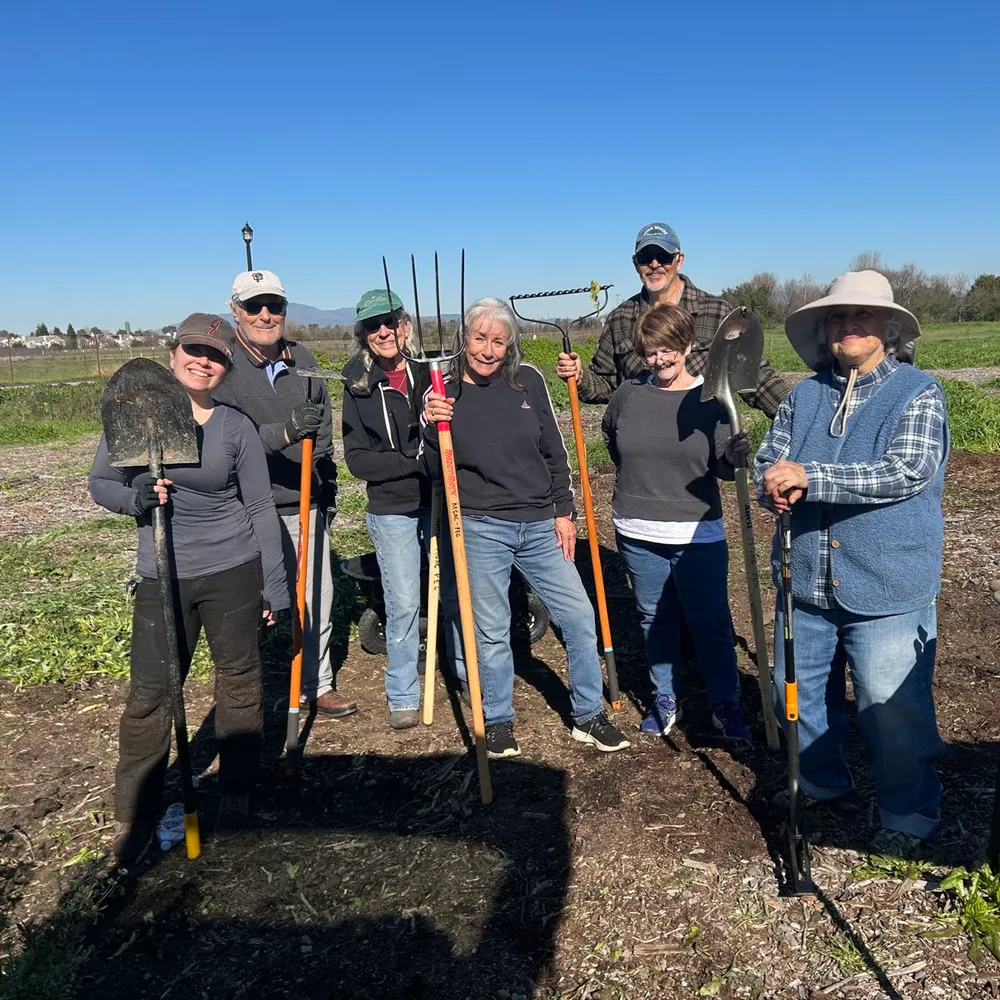
UC Master Gardeners of Alameda County, a program of University of California Cooperative Extension, Agriculture and Natural Resources, has partnered with the City of Pleasanton to launch the Pleasanton Educational Garden, located at 550 Laguna Creek Lane near the intersection of Valley Avenue. This multi-phase project has been in the works since 2015. The one-acre site is dedicated to enriching Alameda County through hands-on demonstrations and sustainable gardening education. Officials note the garden will not have a single focus but include a broad range of plantings such as edibles, landscape plants, and native plants.
“Our vision is to demonstrate all the things our county members may be considering in their gardens, from a waterwise garden to a pollinator garden to growing vegetables, water capturing, and more,” says Lopez, who invites community members, local groups, and corporate volunteer teams to reach out to learn how to help bring the Pleasanton Education Garden (PEG) to life. “PEG will demonstrate sustainable garden practices, with a waterwise garden, bee pollinator garden, an orchard, vines, an education pavilion, a research area, and also vegetable crops to donate to food security groups.”
A new 40-foot shipping container has been installed onsite for essential tool and supply storage, complete with a professionally prepared gravel base. But work remains to complete the first phase of the project. In December 2025, UC Master Gardeners launched a major fundraising push with UC ANR Development Services and raised $41,500 in a dedicated account strictly for the Pleasanton Education Garden. More funding is needed before the group can install a critical one-acre perimeter fence for pest exclusion, which is essential to protecting the site. Phase 1 also includes installing an irrigation system for the row crop area and constructing nine vegetable row beds, so the group volunteers can begin growing seedlings for future plant sales and crops for donation.
Volunteers say the PEG is important for a variety of reasons. “First, we are making university-backed climate science available to residents and the public,” notes Lou Astbury, Master Gardener Volunteer and PEG Leadership Committee member. “Our primary focus is extending best practices for beautiful and sustainable gardens, horticulture and pest management. Second, this is going to be a beautiful, hands-on community learning hub. This garden will provide demonstrations, lectures, classes, and workshops where residents of Alameda County and beyond can learn in a beautiful landscape blooming with fruit trees, vines, crops, and demonstrations of water catchment and conservation. Beyond learning, it will be a beautiful community gathering place to restore the spirit and feel good about the world. Third, because the main focus is sustainable agriculture, this garden will ultimately grow and donate fresh, organic produce directly to local food banks to fight food insecurity."
“The UC Master Gardener Program is vital because we translate complex university science into local backyard garden successes,” adds Lopez. “We empower residents to conserve water, build climate resilience, and reduce the use of harsh chemical pesticides. Ultimately, we don't just teach people how to garden. At the Pleasanton Educational Garden, our volunteers will grow and donate hundreds of pounds of fresh, organic produce directly to local families in need.”
For more information about the Pleasanton Education Garden, please visit www.ucanr.edu/site/uc-master-gardener-program-alameda-county/pleasanton-educational-garden.
To donate to the Pleasanton Education Garden, please visit www.give.ucanr.edu/forms/Alameda-MG-PEG and select Alameda County Garden Education Center - Pleasanton.
For more information about the UC Master Gardener Program of Alameda County, please visit www.ucanr.edu/site/uc-master-gardener-program-alameda-county, www.facebook.com/AlamedaMG, www.instagram.com/alamedamg/?hl=en, or www.youtube.com/c/AlamedaMG.
For more information about gardening in the Tri-Valley, please see www.hacienda.org/news-events/hacienda-online/pulse/2025/feature-stories/tri-valley-gardeners-paradise or www.hacienda.org/news-events/hacienda-online/pulse/2021/feature/tri-valley-gardening-creates-abundant-opportunities-for-growth.
Hacienda News and Information
Hacienda Online provides a great way to stay informed of all the latest at Hacienda


