


Pleasanton Updates Climate Action Plan
Pleasanton Updates Climate Action Plan
At the beginning of April, the Intergovernmental Panel on Climate Change (IPCC) released its most recent report, Climate Change 2022: Mitigation of Climate Change. IPCC is the organization tasked by the United Nations to assess the science related to climate change. "We are at a crossroads. The decisions we make now can secure a liveable future. We have the tools and know-how required to limit warming," said IPCC Chair Hoesung Lee when the report was released. "I am encouraged by climate action being taken in many countries. There are policies, regulations, and market instruments that are proving effective. If these are scaled up and applied more widely and equitably, they can support deep emissions reductions and stimulate innovation."
Limiting global warming will require major transitions in the energy sector, according to the report, including "a substantial reduction in fossil fuel use, widespread electrification, improved energy efficiency, and use of alternative fuels." There is also good news in the report, which points out that options exist in all sectors to "at least halve emissions by 2030." In fact, "having the right policies, infrastructure, and technology in place to enable changes to our lifestyles and behavior can result in a forty to seventy percent reduction in greenhouse gas emissions by 2050," according to Priyadarshi Shukla, Co-Chair of IPCC Working Group III, which produced the report with the help of 278 authors from 65 countries and nearly 60,000 expert and government review comments.
California Leads Nation
"The Golden State reached its 2020 climate change goal four years early, bringing economy-wide emissions back down to 1990 levels without most Californians noticing that anything was different," according to the Los Angeles Times. "But the state's next target, a 40% reduction in climate pollution by 2030, will be a much bigger lift."
Earlier this year the Governor of California proposed adding $22 billion in new climate funding to the State budget for 2022-2023. Today, every state and city need to do their part to cut greenhouse gas emIssions (GHG). The City of Pleasanton stepped up in February by approving the Pleasanton Climate Action Plan (CAP) 2.0 after a nearly two-year process. The city's original CAP, which was adopted in 2012, needed updating to reflect the most recent developments in climate science as well as related regulations and initiatives on the state, regional, and local levels, according to officials in Pleasanton's Community Development Planning Division. As part of creating CAP 2.0, the city held more than 20 public hearings. Its efforts to educate the public and attract community input included surveys, social media postings, workshops, focus groups, and additional community meetings.
Climate Action Plan 2.0
"The CAP 2.0 builds off the success of CAP 1.0 and evolves to align with updated state, regional, and local policy," says Megan Campbell, Associate Planner in the City of Pleasanton's Planning Division. "It creates a clear path forward for the next 10 years in the City. We have simplified the document significantly, focusing on the most impactful, actionable, and achievable actions."
The updated CAP includes a set of primary actions meant to reduce or mitigate GHG emission and secondary actions targeted predominantly to adaptation and resilience in the face of climate change. According to the City's research, the CAP 2. 0 range of primary actions will result in estimated annual costs to the City of approximately $273,000, with annual cost savings to the community of approximately $585,000.
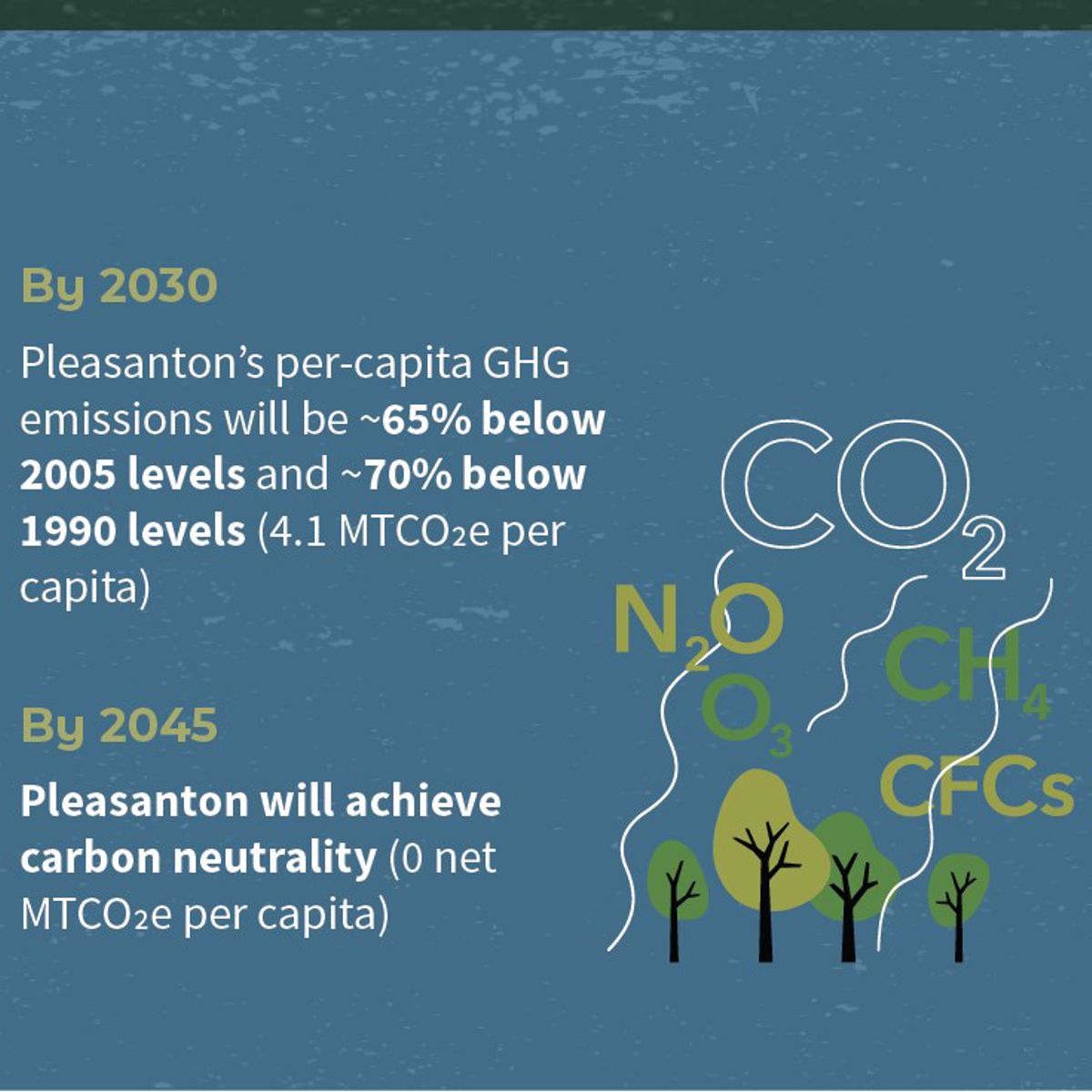
"The CAP 2.0 doesn't exist in a vacuum," notes Campbell. "There are several City, County, and regional plans and efforts that already exist and inform to some extent the environmental context. For example, the Tri-Valley Local Hazard Mitigation Plan, the City's General Plan, the City's Bicycle and Pedestrian Master Plan, and Plan Bay Area 2040. CAP 2.0 is intentionally aligned with and builds upon these plans and efforts. Further, the State has key pieces of legislation and executive orders that set statewide GHG emission reduction targets. These include SB 32 and EO B-55-18. The CAP 2.0 complies with these statewide targets by aiming for per capita carbon neutrality by 2045 and a 70% reduction below 1990 GHG emission levels by 2030."
According to the CAP 2.0 summary, the plan includes "strategies and actions to electrify new and existing residential, commercial, and municipal buildings and increase the amount of renewable energy and storage for new buildings. It recommends increasing electric vehicle (EV) charging stations to encourage greater EV adoption in the community, and development patterns that emphasize complete streets that allow people to go about their business on foot, by bicycle, or via public transportation. It also offers ways to reduce water use and divert organic and inorganic waste that would otherwise go to landfills. In addition, CAP 2. 0 includes strategies and actions to increase urban greenspace and trees for carbon sequestration and to provide community education and outreach regarding CAP 2.0 and local sustainability efforts."
A Gap Remains
The CAP 2.0 accounts for State legislation that will reduce emissions in Pleasanton even without local action as well as all of the existing actions the City is actively undertaking, according to Campbell. There is still a gap, however, between the City's emission reduction targets and projected emissions. Thus CAP 2.0 relies on several actions across six sectors to meet emission reduction targets.
In Pleasanton, the largest sector of GHG emissions is transportation, followed by energy use in buildings, according to Campbell. "Brought to light through the process was the importance of electrification of cars and electrification of buildings. That push toward electrification underlines the importance of ensuring a robust regional electrical grid that minimizes the risk of power outages and expands to manage increased capacity. It also highlights the importance of increasing local renewable power generation and storage."
Some of the actions in CAP 2.0 include requiring certain projects to install solar and battery power backups or include electric vehicle charging, notes Campbell. Other actions are voluntary. The City plans to prepare and implement an existing building electrification plan, for example, that includes grid analysis and municipal building electrification; encouraging community electrification through incentives and permit streamlining; and conducting outreach and education.
"The City commits to building a toolkit, or permit guide, that identifies the steps needed to electrify, promote rebates and incentives, streamline permits to the extent possible, etc.," explains Campbell. "We will be looking to residents and businesses to actually make the changes to their buildings. We will be working closely with Hacienda, and other associations, to promote these voluntary actions."
For more information about the Climate Change 2022: Mitigation of Climate Change report, please visit www.ipcc.ch/report/ar6/wg3.
For more information about the Pleasanton Climate Action Plan 2.0, please visit www.cityofpleasantonca.gov/gov/depts/os/env/cap/default.asp.