


Pleasanton: A Downtown Renaissance
Pleasanton: A Downtown Renaissance
Pleasanton's unique personality is in large part attributable to the many historic structures and commercial building concentrated in the downtown area. Pleasanton has grown over the last decade with impressive new office buildings and tracts of contemporary homes giving the city a vigorous new identity.
But, at the same time, newcomers and old-timers alike, have taken great pride in the charm and character that turn-of-the-century structures lend to the city.
Some business park developers have shown their appreciation of Pleasanton's history as well. Callahan-Pentz has invested in both the city's future and its past with its development of Hacienda Business Park and its downtown redevelopment project of the old Arendt Building at 450 Main Street.
Work on the project is almost complete now that spring rains have ended and several tenants are ready for their grand openings. Driving down Main Street, one is struck by the impressive new brick additions which were sandblasted to blend with the original brick facade. Large store front style windows will face Main Street and Neal Street where retail tenants will occupy the downstairs units. Traditional double sash windows front the offices on the second story.
Connecting with the renovated and rebuilt Callahan-Pentz project is Clyde Vaughn's 400 Main Street project. Vaughn is a Pleasanton resident who bought the Main Street property in the late 70's with the goal of constructing a "first class building in keeping with the old downtown flavor."
Designer-builder David Powels was inspired by the style of the Kolln Hardware building. An eight-sided, domed and shingled cupola similar to Kolln's is already in place on the corner of Main and Angela streets. The building will be painted an almond color with contrasting trim and will be completed by mid-July.
There are other downtown projects, big and small, that reflect downtown pride in Pleasanton's unique mix of old and new. The small Mission Revival style gas station at Main Street and St. Mary Street recently received a fresh coat of paint and Gene's Flooring just completed an annex on St. Mary Street which successfully captures the flavor of turn-of-the-century storefronts.
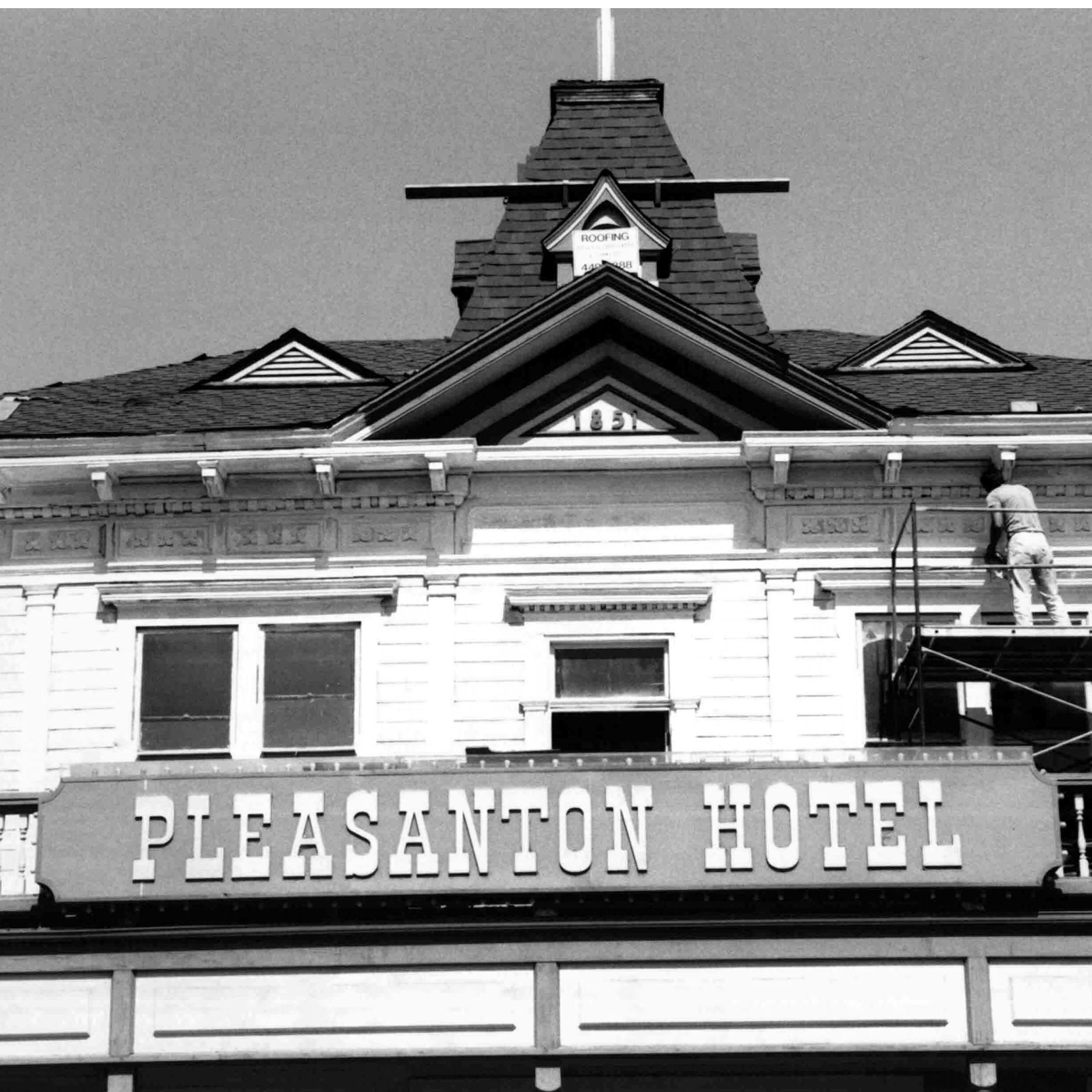
The Pleasanton Hotel, probably the most familiar and widely recognized Pleasanton landmark, is currently undergoing extensive renovation. Originally called the Farmer's Hotel, the first structure was built in 1851 by John W. Kottinger. A fire in 1898 and another in 1915 destroyed the original building. The present structure was rebuilt in 1915 in the Italianate style to resemble the original 1851 hotel.
The current renovation project will replace the roof and refurbish and redecorate the upstairs rooms which have been closed off and unused for many years. They will be opened and leased as offices for small local businesses.
Located at 603 Main Street, the old City Hall and Library building also served as Pleasanton's Police Headquarters. It is now the sparkling new headquarters of the Livermore Amador Valley Historical Museum.
This building is neo-Spanish Colonial in style and was built in 1914. With its renovation for museum use, the exterior was repainted in traditional beige with white and tan accents and the interior was refurbished and repainted for exhibition use. Open Wednesdays - Saturdays from 1:00 - 4:00 pm, the museum shows a variety of historic objects and contemporary art works.
Kottinger Barn, located at 200 Ray Street, was built in the 1850's and was recently placed on the national register of historic places. To qualify for the national register, three fourths of the barn's original structure was preserved during restoration.
Kottinger Barn now houses an antique collective, but started out as an adobe barn and later served as a jail when John Kottinger was Justice of the Peace for Murray Township. The original iron bars from the jail can be seen in the window openings.
The Johnston Building located at 465 Main Street, across the street from the 450 Main Street project, was built in 1896 and is currently occupied by Kennedy Business Machines. It is an excellent example of a 19th century commercial building. The facade is a three-bay, pedimented design with second story Palladian windows.
The building received extensive renovation in the '70's. The exterior was sandblasted, cement floors were put in and the brick skeleton was reinforced with steel beams. It was considered to be one of the most luxurious downtown buildings in its day and still creates quite an impression on Main Street visitors.
Kolln Hardware, located at 600 Main Street, is as much a symbol of the downtown business district as any other building. It was built in 1896 and has served as a hardware store since that date. Its large corner cupola, combined with the downtown arch, welcomes visitors entering downtown from the west.
Not of the turn-of-the-century era, nor a building, the Pleasanton Sign arching over Main Street is nonetheless, one of the most significant historic structures in town. Built in 1932, it was the first neon sign in the city. It also served as the city's police communications system when it alerted the Police Chief with its flashing lights and horn. Probably the most photographed and reproduced landmark in Pleasanton, the sign serves as a gateway to downtown.
According to design associates involved in the planning of Hacienda Business Park, the arch which dramatically spans the entrance to the business park was inspired by Pleasanton's famous downtown sign. Both serve as symbolic entries to two vital and important areas and represent the traditions of the past and the excitement of the future.
To see a reproduction of the original article and edition of Pleasanton Pathways, visit: June 23, 1986 Pathways.