


Commuters to Benefit From Valley Link Plan
Commuters to Benefit From Valley Link Plan
Public transit has a remarkable history in the United States. For example, the first publicly operated ferryboat was established in Boston, Massachusetts in 1630, according to the Federal Transit Administration’s National Transit Database. Just over 100 years later, ox carts in New York, New York carried American passengers for the first time. In 1811, also in New York, the first steam-powered ferryboat started. The first horse-drawn omnibus began service along New York’s Broadway Street in 1827.
Three years later, the first railroad began operation in Baltimore, Maryland. The first streetcar and first horse-drawn rail cars in America kicked off in New York in 1832. In Boston, the first commuter fares on a railroad were established by the Boston & West Worcester Railroad in 1838. And in 1873, the first cable car in the world welcomed riders as it traversed Clay Street in San Francisco.
Many Commute Options
Commuting to work has a long history as well. The San Francisco to San Jose Rail Road was the first commuter train of the West. Completed in 1864, the trip from San Francisco to San Jose took less than 2.5 hours. “Due to the cost of the trip, only the elite could work in the City and live on the Peninsula,” according to documentation from the San Mateo County Historical Association.
The number of public transit forms has expanded dramatically over the years. Those commuting to Hacienda, for example, have access to the Dublin/Pleasanton BART station, the Altamont Corridor Express rail service, and the Wheels Service that runs buses throughout the Tri-Valley. Those are not perfect options for everyone, which is why many so-called supercommuters, individuals who commute 90-minutes or more one way to work, may find themselves driving in slow, congested traffic along Interstate 580. Many of those commuters live in San Joaquin County, where affordable housing is more available than high-wage jobs.
Valley Link Project Adapts
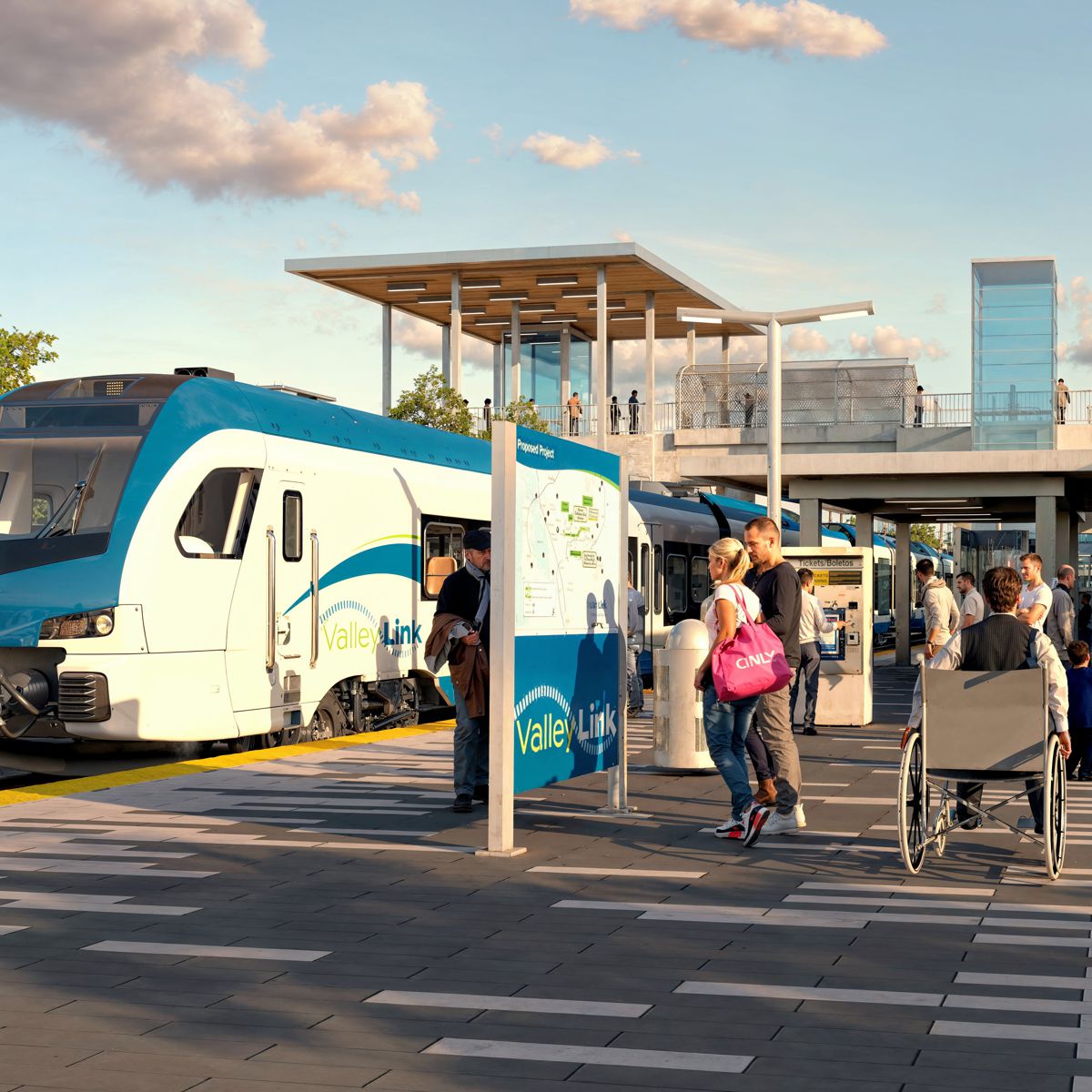
Originally proposed in 2017 by the Tri-Valley-San Joaquin Valley Regional Rail Authority, Valley Link is a new rail line meant to reduce the estimated 170,000 drivers who travel from their homes during the week over the Altamont Pass and along 580 into the Tri-Valley and beyond to work and then back again. Such traffic not only clogs the roadways and slows travel but also contributes significantly to hazardous air pollution, which has been documented as a serious health hazard. Valley Link was also conceived as a way to achieve transit connectivity between BART’s rapid transit system and the San Joaquin Regional Rail Commission’s Altamont Corridor Express (ACE) commuter rail service from the San Joaquin Valley to the Tri-Valley.
Initially, Valley Link was intended to be a 42-mile long, zero-emission system running between the Dublin/Pleasanton BART Station in Hacienda to Lathrop. But the project hit several bumps. The Covid-19 pandemic, which stopped many things in 2020 and after, affected Valley Link as well. A related jump in the cost for construction materials was another issue. By early 2025, the expected costs had doubled to about $4.4 billion.
In response, Valley Link's team reviewed the project to see what could be achieved for the original roughly $2 billion budget while still maintaining the mission to create an ACE to BART connection. In June 2025, the Valley Link board agreed to a smaller, less ambitious, and more efficient plan. The Phase 1 part of the project has been split into two 11-mile phases. Phase 1A comprises construction of Valley Link from the Dublin/Pleasanton BART Station to the Vasco Road ACE Station in Livermore. That construction is fully funded and expected to begin in 2028 and be completed by 2031. Phase 1B entails construction from a new Valley Link Southfront Road Station in Livermore to a new Mountain House Community Station. Funding for Phase 1B remains to be determined.
Kevin Sheridan, Valley Link Rail Authority’s Executive Director/CEO understands that commuters may be disappointed by Valley Link delays. Even so, he believes the wait for Valley Link will be worth it because of reduced vehicle traffic, improved air quality, and easier commute experience for those who ride the new rail service. The Valley Link connection at Vasco Road inPhase 1A will be a significant advancement as it will allow commuters to connect to BART directly by rail via ACE as far away as Stockton, Lathrop/Manteca, and Tracy. Overall this will significantly reduce congestion over the Altamont Pass; connecting jobs to housing and further supporting economic development. The project will now have transit hubs at Hacienda and Vasco, while supporting economic development in Livermore at Isabel Avenue and Vasco Road.
“Valley Link got started in 2017 to establish an ACE to BART connection in the Tri-Valley,” Sheridan notes. “That is exactly what we've come back to, establishing that ACE to BART connection in the Tri-Valley.”
Commuters may see additional benefits from the project as well, according to Sheridan. “We're also coordinating and partnering with ACE, an existing rail operator that lots of people know and take.” Sheridan says his agency is talking to ACE officials about ACE running more than four trains a day in the future, when Vasco Road ACE station will have more room for parked trains, which could potentially lead to more than four daily ACE trains in service.
Many regional elected officials support Valley Link. At a Valley Link town hall meeting in Tracy last January, several spoke in favor of the project. “I commute,” California State Senator Jerry McNerney of Pleasanton told the crowd, according to Tracy Press reporter Bob Brownne. “I live in the Tri Valley. I commute over here, and I commute back. I get stuck in traffic, just like everybody else. It's soul crushing.” He added, “We want to make sure that people have an alternative to do a couple of things to relieve the commute, to clean up the air quality, to improve the quality of life for people in both parts of my district.”
Christina Fugazi, Mayor of Stockton, Chair of the San Joaquin Council of Governments, and a member of the San Joaquin County Regional Rail Commission Board of Directors also spoke at the town hall meeting, according to Brownne. “If you have over 100,000 vehicles going over the hill every single day, what is happening with everything that's coming out of those cars?” she said at the meeting. “Quality of life is affected, mortality rates are affected. Incidences of upper respiratory disease are increasing; they're not decreasing, which is what we would hope with the advancement of alternative fuels.”
Commuters will not be stuck with the status quo forever. Progress toward improvements are being made, and Valley Link is one promising example. “Valley Link seeks to make a mega-regional improvement between the San Joaquin Valley and Tri-Valley,” notes Sheridan. “In doing so, it will offer people a direct rail connection as an alternative to driving over the Altamont every day. Valley Link will close a gap between two different rail services to complete an entire rail network of hundreds of miles for probably the least cost of any project in the state.”
Until Valley Link goes into operation, many alternatives to driving remain. For Hacienda tenants and their employees, those options include carpools and vanpools, in addition to BART, ACE, and WHEELS services. Hacienda also offers a Commute Resource Center to help individuals plan their commutes.
For more information about Valley Link, please visit www.valleylinkrail.com.
For information about Hacienda’s special commute and transit offers, please visit www.hacienda.org/amenities/employees-residents/commute-solutions.